The Last Conversation

the last conversation
has mostly faded,
but i still remember one thing.
with hollow eyes
and a look i might
only describe as fear,
my mother said something like,

“I’m afraid your father
might be in hell, Dan.
Weren’t his last words
who’s there? and
why is it so dark?”

No one knows
my father’s last words.
A nurse said he simply asked,
“What’s happening?”
Yet, somehow my mother twisted
those words to have more
meaning in her own mind.

Did she wonder if my father
went to hell out of concern?
Or was it that same old judgment
clean to the end, that sense
of competitive righteousness?
Or maybe, she was afraid
for her own place
in the afterlife?

Why I Love A Cult of Lies

If you follow me, you know I have four different musical projects. It’s hard saying, but I think my favorite might be A Cult of Lies.

Here’s the first album from 2021.

First, here are the four projects:

  1. Dan Steven Erickson: This is me and the name I use for my singer-songwriter work. And I’ve done a serious amount of songwriting over the years. You can hear some of my demos on the songs page.
  2. Anderhill: I began to experiment with electronic music about 10 years ago. I did several projects of both songwriting and instrumental albums. But that was the learning stage. I scrapped about three years of work and started Anderhill in 2018 as an experimental electronic music project.
  3. The OWG: Although Anderhill’s sound does include some drums and beats, I created The OWG for my music that is built and driven by electronic drum programming. I’ve even considered rapping to this music. OWG stands for “old white guy” and the name was given to me by one of my daughter’s friends. I haven’t done much work as The OWG lately.
  4. A Cult of Lies: Sometimes it’s hard to distinguish the difference between A Cult of Lies and Anderhill. I think the distinct sounds are still developing. At the start, A Cult of Lies was a darker and noisier sound. But it’s grown into something different. A Cult of Lies is often darker than Anderhill, but not always noisier. The sound is becoming more drone-based and the compositions longer.

Here’s why A Cult of Lies might be my favorite.

The most recent albums by A Cult of Lies are great to listen to. I’ll list and link all of the albums below. The most recent works are dark yet soothing. They are deep and relaxing, meditative. The first two albums were a bit different, more noisy, but time has led to a more distinct “Cult of Lies” sound beginning to form.

I can listen to A Cult of Lies while doing other projects without distraction. The music can help me to sleep. There is a droning and meditative feel that is subtly different than anything else I’m doing. While much of Anderhill’s music shares this quality, I’m slowly working toward making more distinctions between the two musical projects.

A Cult of Lies Albums to date and the future.

I’ll continue to produce music as A Cult of Lies. Sometimes, I think A Cult of Lies could become my primary work. But for now it’s still a side project.

The production of music without words is most rewarding to me. There are less expectations. When I write songs as a songwriter, there’s a bigger part of “me” in them, and that part of me wants to be heard. But in today’s world of music, getting your music to a large audience is tough. So, traditional songwriting can become discouraging and feels like it’s all being done in vain.

It’s not the same with experimental and ambient music. I don’t care who listens to it. In fact, I probably listen to my work as A Cult of Lies more than anyone else does. I have no definitive plans for the next album, maybe another one in 2024, maybe 2025? I often release the work as singles and then work those into an album. I’ve got several potential projects underway, but A Cult of Lies might just be my favorite. – dse

Writing on Writing Online

I teach a feature writing course at Yakima Valley College. It’s currently a fully-online course. As much as I prefer teaching face-to-face, I’m convinced that this writing course is becoming a better course in its online format.

What makes me say that? Because, most generally, my students are becoming better writers. I don’t like to take too much credit, but I do think that the way I’ve organized the online course is a strong indicator of the success of the course.

In the course, there are weekly poems and articles about writing. Students not only write feature articles, but they spend time reading and responding to award-winning feature articles. They practice writing ledes, nut graphs, interviewing, headlines, and query letters. There is a mix of non-graded, short graded assignments, and three major feature articles.

Each quarter it feels like I’m receiving higher quality work than the quarter before. So, something must be working, even if it is online. This makes the work and feedback from my end well worth the effort.

Although it’s working well, I will be making some updates to the course in the near future, adding a few more non-graded examples, and perhaps some visualization exercises.

If you are interested in taking the course, it’s CMST 140 at Yakima Valley College. Maybe, I’ll see you online. – dse

I Don’t Believe in Writer’s Block

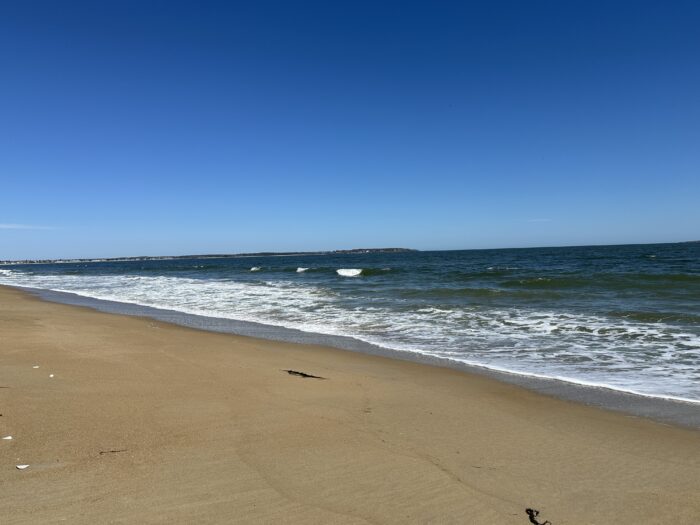
Old Orchard Beach – Photo by Dan Steven Erickson

I believe in writer’s block about as much as I believe in writing being a supernatural process. Zero.

Recently, I wrote about how songwriting is not some kind of magical process. Songs don’t magically appear. They aren’t inspired by some universal power, although they can be inspired by your own interests in a topic. Writers are not conduits to some mystical process. Writing is hard work. And that’s exactly why I don’t believe in writer’s block.

When I was younger, I might have had times when I felt like I was stuck, like I’d never write another song or poem before my life ended. But I’m happy to report that that hasn’t happened for at least 10 years. And there’s a simple reason for it.

I write. Period.

Let me repeat that. I write. And writing is work.

You can only convince yourself you’re stuck.

If there is no secret power guiding us as writers, then we have complete control in how we write. That includes how often we write, where we write, when we write, and what we write. And I’ll say it again. Writing is work. Writer’s block is nothing but an excuse to not want to do the work. Period.

Will there be times that we are less inspired to write than others? Absolutely. Will there be times when the exact song or poem or story you sit down to write isn’t easily coming? Of course. That’s life. You don’t always feel like going to work or washing the dishes either. But just because there are times when writing is harder than other times doesn’t equal “writer’s block.”

I can’t count the number of times I’ve sat down to write about a specific idea and wound up staring at a screen, or writing a short amount and hitting the delete button. That’s not writer’s block. I simply was not in the right mindset to write what I thought I might at that moment. Instead, I might change topics or take a break. Or journal.

Ways to beat the down times.

First of all. you don’t always want to beat the down times. Sometimes, when we are less inspired to write it’s because we need a break. You take vacations from work. You take breaks from relationships. Taking short, or even extended breaks from writing, is not a bad thing.

However, if you feel like you just can’t get into the groove of writing, there are dozens of ways to reset or refresh, including resisting distractions. I’ll include a few of my favorites here.

  1. Go outside and get active: Exercise stimulates the mind. For me, getting outside into nature and simply walking helps tremendously. It gives me time and space to contemplate.
  2. Practice another creative process: So you’re staring at a blank page. Go play your piano. Take some photos. Practice an alternate creative process for a few hours, days, or even weeks. Writing will come back around.
  3. Write in a different genre: This is my favorite tactic. Why? It works. If you call yourself any kind of writer but then tell me you have writer’s block and can’t write anything, I might not believe you’re actually a writer. It’s not hard to write something. I’ve spent the last 15 minutes writing this essay. When you struggle with a specific writing project, write something else for crying out loud. You’re a writer, right? Work on a poem when you’re stuck on your novel. Write an essay when a song won’t come. It’s simple, but it’s work.

So, next time you think you have “writer’s block,” remember, writing is work. You likely are not blocked. You just are not in the mood or space to do the work. Take a break or write something else. If you really want to complete a writing project, you will. – dse

Little

in the big picture,
you’re so little,
and what you do
of little significance.

does anybody really need
another pop song
or a predictable photo of a sunset?
will your paint-by-number
art change the world?
does your sermon
really matter?

who are we to believe
we have any purpose
beyond simply serving
something higher than ourselves,
be it God or the greater good
of collective humanity?

you’re little and so are you’re
so-called works of art.
but if your little work
touches or teaches one soul,
if you make one person
think or feel,
maybe you’ve done
a little good in this world.

Creativity: It’s All Part of Something Bigger

Lately, I’ve been contemplating the creative process and my artistic place in this world. One conclusion that I’ve come to is that our creativity is purely a human process. There may be some internal magic, but it’s all based on our own life experiences and our willingness to work hard.

In a recent post, I said that artists who claim that they have some kind of mystical process, or act as conduits to some greater power come off as pretentious or superstitious. After that post, someone asked me why I care. They asked why I can’t…

just let everyone believe what they believe and find joy in their own process?

My response was simple. I don’t really care what one’s creative process is. If you want to claim you wake up at midnight and sleepwalk to the graveyard and channel Robert Johnson through a direct connection with the devil, go for it. If you say you step inside a church and suddenly you’re writing down lyrics to the next best-selling praise song. Amen.

Why contemplate the creative process?

My look into my own process is deeper than just wanting to understand creativity. It’s “spiritual,” if you will. I was raised in a Christian family. I was the child victim of an extreme religious cult. I’ve spent at least 25 years of my adult life actively practicing Christianity, attending churches, reading the Bible (more than five times), actively prayerful, etc. But something started changing when I was in my 40s, and that change has slowly led to some deep contemplation about what we refer to as God.

If you’d have asked me 20 years ago where my songs came from, I might have claimed there was some external power that helped me. Call it God, the muse, whatever. Heck, I might have made that claim five years ago. But I’ve come to some personal realizations. And that’s what I’m referring to when I say my deep look into my own creative process is part of something bigger. It’s a shift.

It all started years ago when my dad told me two things that he had come to believe about God.

  1. God loves all people and all people will be “saved.”
  2. There is no literal devil.

If you’re religious, I know what you’re thinking. Heresy. But if you have an open mind, let’s set that thought aside for a few minutes. I love the idea of universal salvation and want to believe in a God that is that loving. If there is a God, I believe he/she is that loving. But it’s the second concept that has slowly changed the way I think about God, religion, and now creativity.

There is no literal devil.

I take this to mean that, not only is there no horny red guy with a tail and a pitchfork in a fiery place, but there is no external evil spirit that tempts you and lures you into sinful behavior. That’s all you, baby. You fall prey to immoral thoughts. You decide to do things that might be considered inappropriate or evil by any given society’s standards. You!

One thing leads to another.

Over the past ten years, this concept that the devil does not really exist has changed how I view God. If there’s no devil leading us astray and we actually need to take responsibility for our own behaviors and admit that we were wrong, then doesn’t that work in both directions?

Seriously, do you think there is a physical or spiritual God-like entity that blesses you for good behavior? I was taught if I just prayed hard enough, if I only believed strongly enough, that I would be blessed, that good things would happen to me. I think I’m safe to say that that is part of the basic Christian mindset.

Bullshit.

And here’s where we get back to creativity.

Coming to the conclusion that creativity is a distinctly human activity has led me to understand that we are not spiritual conduits for some kind of magical process. We are that process. We are the “magic.” We are like God.

I’m teetering on the fence between believing in a God and becoming an atheist. Years of studying and practicing religion has actually led me to see how foolish it can be. Imagine grown adults all believing in a literal Santa Claus, Easter Bunny, Tooth Fairy, or the Devil? I’ve concluded that my life is no different, neither blessed nor cursed, whether or not I pray or read a certain book. Both good and bad things happen to everyone. Still, one thing continues to keep me on the side of believing in a God. Creativity.

But you said creativity is a strictly human process.

That’s right. I did. And I do believe that. There is no secret power that zaps us with the magic to write great songs or create great works of art. That comes from our genetical make up and a ton of hard work.

But one of the first things said in the Bible is simply that “God made us in his own image.” Bam. There it is. Creativity. If there is a God, a maker of the universe and all life, he or she is creative. And we were made in that image. That means we are internally and naturally creative beings. It also means that we have the power to decide when and how we use that creativity.

So as I said in the title of this essay, “it’s all part of something bigger” going on within me. I’ve come to two ultimate conclusions:

  1. Either there is no God and we control our own lives to the point that we can.
  2. Or there is a God, but rather than it being the God the modern church has shoved down our throats, he or she is solely a creator-God, and we in turn are creative beings.

So why do I care? Why does it matter if some creative people want to believe that they are blessed by God and have some sort of supernatural power coming through in their work? Personally, it doesn’t matter.

But collectively, I think it does. I think that an artist who makes claims of some kind of other-worldly process, magic, or spiritual insight is not bringing light to a “God,” they are only making pretentious claims about themselves. They paint themselves as being on a higher level than the “average creative.” They are claiming to have some kind of magic beyond our simple humanity. They are claiming that they don’t work for it, that they are magically gifted, and that makes them more worthy of praise and critical acclaim. See the problem? It’s disingenuous and ego-based.

As for me, I prefer humility. My ability to be creative may or may not be the result of a higher power. But I’m not special because I can write halfway decent poems and songs. There is no magical process. The words and music are not planted in me by some external spirit. I am human. I am creative. It’s part of how I comuunicate my humanity.

I am creativity. It’s in me. But I have to work hard to put that creativity onto paper and into music. I am human. My creative works are human. I’m proud of that. We should all be proud of our human experience and our ability to communicate that experience through art. – dse