If you’ve been following me awhile, you’ve probably watched me go from writing books to minimalism to ambient music to songwriting. You might wonder what’s going on. Can’t I focus on one thing? I ask myself that same question sometimes.
However, here’s the deal. I’ve been a songwriter forever. So my direction toward writing about, and sharing my work as a songwriter is really simply me becoming who I really am. As for minimalism, well, it wasn’t just a phase, it’s just not a primary focus. I always have and always will apply some minimalist principles to living.
So What About Anderhill and Ambient Music?
That’s a good question, and I’m sorry but I don’t have an absolute answer. I turned to writing ambient and drone music as a break from traditional songwriting.
I’d been writing songs for more than 30 years and I was a little burned out. I’d also started experimenting with electronic music programming around 2015. Those experiments went from some pretty crappy song demos to composing unique and interesting ambient and drone music.
Creating ambient music was also a great pastime during Covid.
So why did I stop? Simple. The songwriting bug bit again. I haven’t composed much ambient music since early 2024. Before that I was creating a plethora of LPs, EPs, and singles. Here’s a short review of my three electronic music projects:
Anderhill is my first electronic project. It’s mostly a project of experimental electronic music that plays with a variety of genres, including ambient, drone, house, and even Neo-classical.
A Cult of Lies was created when I made an album that was much darker than anything I’d ever composed as Anderhill. It felt different. So A Cult of Lies became the name for a darker ambient and drone-based project.
The OWG is reserved for my electronic work that is more “beat” focused. While Anderhill may or may not use beats, A Cult of Lies rarely uses beats at all. The OWG (Old White Guy) is my project for playing with more with beats and drum programming.
The Future of My Ambient Music Projects
It’s probable that I’ll compose more ambient music in the future. I might even do one or two new projects this year. But currently I’m focusing on songwriting, and particularly in the Blues genre. Who knows, maybe I’ll move to Mississippi, work into the blues clubs in Memphis, and never look back.
However, even if I dabble in performing the blues, it might not become my life’s calling. And I might not want to live just south of Memphis. I might rather choose somewhere further West and quieter.
I’ve always had the idea of doing a project that combines ambient music and photography in the Great Plains. Who knows? – dse
Clarksdale, Mississippi – Photo by Dan Steven Erickson
Warning: this is a long article.
I’ve had an on/off relationship with the blues for more than 30 years. I’ve also written gospel and contemporary Christian songs throughout my songwriting journey. I think the blues are a better art form and I’ll tell you why.
But first, let’s talk about God. That’s right, the subject I tend to put off in any detail but address often in my lyrics.
Here’s a little religious history about me.
1963: Born the son of a Advent Christian preacher.
1963-1970: Attended church regularly until my dad gave up the ministry.
1973: Moved from Maine to Washington to become part of a religious-based cult. See my book, A Train Called Forgiveness.
1979: Escaped the cult.
1979-1990: Avoided religion but still prayed. Mom was a conservative Christian, told me I’d go to hell for certain behaviors.
1990-1993: This period was very important to my current views on religion. I went through a few years of spiritual crisis. I’ll explain later in this article.
1993-1996: Avoided churches.
1996-2020: Attended and played worship music in a variety of Presbyterian and Methodist churches. During this era I got married (1999). I lost my firstborn child, Angel (2001). The second-born, Annie, was born healthy (2005). Started a divorce in 2006.
2020: Stopped attending church
2020-2025: Reexamined my entire view of religion and Christianity.
Of course, my past in a cult has had a great effect on how I see religion. In fact, the more I examine the modern church, the more I am quite positive that it’s literally just another form of cult. But it was the years between 1990-1993 that have even more impact on my views of religion.
My personal religious storm.
Around 1990, I started having some mental-health issues. The only way I can describe it is that it was something like paranoid schizophrenia, although I was never diagnosed.
My mom told me to read the Bible and pray. I did. I probably spent more time reading the Bible and praying than many people do in their entire lifetime. I read the Bible from cover to cover at least five times. I prayed for 30-60 minutes many days.
But I also struggled with substance use, alcohol, marijuana, and tobacco. Nothing hard and I didn’t use to the extreme. Yet, it contributed to my problems at the time.
Here’s what reading the Bible did for me during those years. It scared the shit out of me. I felt condemned. I felt hopeless. I felt like God could never forgive me, that I was beyond redemption. It was only after giving up all substances and going back to college in the summer of 1993 that my mind began to heal itself.
I will say, there was a moment during my religious storm where I felt I heard “the voice of God” and that he told me everything would be okay. But remember, I was having “paranoid schizophrenic-like” symptoms. And for most of three years, I was overwhelmed by voices of fear and condemnation, even when I was clean and prayerful.
My church-going years.
In 1996, I decided to start going to church. I chose the Presbyterian denomination. I’m glad I did. If I ever decide to go back to church, I might choose Presbyterian again.
Throughout my time as a regular church-goer, I played music for the church, I went to conferences, I regularly helped in the church in one way or another. The greatest benefit I found to going to church was the social experience. I met good people and made friends. Going to church might have made me feel good about myself, but it mostly felt ritualistic, as if I was simply going through the motions, repeatedly.
I began to question church. Beyond the social aspect, what was the point? My conclusion was that there really was no point. If there is a God, I had come to believe that God is an all-loving God. I believe that there is no God who would separate his or her children into two camps and send some to heaven and others to hell. If the God that anyone worships would do that, I decided that is not a God I want to worship. And that’s the way every church I’ve ever been to does it, even the Presbyterians.
The power of prayer, or not.
What is prayer. I’m sure many of you will disagree. But it’s simply an act of convincing ourselves we are good people doing the right thing. It might work a little like positive thinking, but I concluded that my life was no better or worse whether or not I practiced prayer.
Whatever happens is going to happen. I lost a child. My ex-wife had extreme OCD. I went to college and started a decent career in higher education. God didn’t do any of that. It just is. And prayer didn’t fix or help anything along the way.
This morning I watched a a black woman in the hotel spend about a minute in prayer before she ate her breakfast. I might guess she included gratefulness and I can appreciate that. But she likely included some personal requests as well. But life will happen as it happens. Another tornado could hit the hotel we are staying at in Joplin, Missouri and bam. Nothing. And to think, if her ancestors had not become slaves of “good American Christians” she’d probably never be praying in the first place. And don’t tell me God directed the slavery movement!
My conclusions about religion.
Religion as we know it is mostly based on the unknown. It’s how humans have chosen to explain the things we cannot know. I would go as far as to say it’s based on the fear of the unknown. We are afraid of death so we must give it meaning. We are afraid of evil spirits, so we must fend them off with the protection of an invisible God. But what if it’s all in our heads?
Second, after moving to the South and seeing such a presence of huge mega-churches, it has further convinced me that our current model of the Christian church is far from what Jesus would have ever expected or wanted. Jesus turned the tables for people making profits in the temples.
I understand that most churches do some charity work, but I also see that most mega-churches are making a shit-ton of money. How? Through donations and free labor. I see the cross used more as an idol than anything else.
So, WTF does any of this have to do with the blues?
I’ve said that the blues and gospel both come from the same place, but from different perspectives. No, blues is not the evil twin of gospel. Blues is the truth. Gospel is weighed down with religious-influenced dogma.
A blues singer will tell you his or her sad story of love and loss. A gospel singer will parrot religious scriptures and sing of faith and hope. A blues singer may still praise God, but might also question God. A gospel singer will only praise and never question. A blues singer will look at life through his or her own personal experiences. A gospel singer only looks at the world through the lens of religion.
One form is conditioned by the whole of life, including the writer’s views of God. The other form is conditioned solely by religion. I have come to the conclusion, therefore, that the blues is stronger, more intellectual, more emotional, more real. And while gospel may play a role in providing some hope to the down-trodden, it’s really only parroting long-held religious doctrine.
All this to lead to a lyric I recently wrote.
The Blues Is My Gospel
I’m going down to the river, gonna sing the blues
I’m going down to the river, gonna sing the blues
Gonna walk along the banks and shout out the truth The blues is my gospel
Good news, good news
I’m gonna climb that mountain and reach for the sky
I’m gonna climb that mountain and reach for the sky
I’m gonna live and be one with the power up on high
The blues is my gospel
Good news, good news
I’m going deep down in my heart, gonna purge out my shame
Then I’ll go down to the delta and call out his name
Jesus, Allah, or music, it’s really all the same
The power lives in my freedom to choose
The blues is my gospel
Good news, good news
Now, I’ll play this old guitar until the day that I die
Yeah, I’ll play this old guitar until the day that I die
I’m gonna live and be one with that power up on high
The blues is my gospel
Good news, good news
I’ll go down to the crossroads where good things meet
Then I’ll sing that message loud, right on out in the street
You know, I won’t glorify anybody else’s defeat
Cuz we’ve all got the right to win or lose
The blues is my gospel
Good news, good news
I’m going down to the river, gonna sing the blues
I’m going down to the river, gonna sing the blues
Gonna walk along the banks and shout out the truth
The blues is my gospel
Good news, good news
The blues is my gospel
Good news, good news
I’ve been writing the blues off and on for years. The more blues I write, the deeper I go. My blues lyrics aren’t just about drinking and cheating, and losing my woman. They’re existential. I question personal values and collective ideologies. I get philosophical. And it’s still the blues.
So what about Gospel? Recently I posted this on Facebook:
The blues and gospel are two sides of the same coin. The blues is personal. It’s about individual struggles and transformation. Gospel is communal and it doesn’t have to be about God or religion, but rather about love, hope, and independence from oppression for the marginalized. And when you figure this out, you’ve got the key to the highway.
So what if we take God out of Gospel? Keep that upbeat, hand-clapping style, but instead of singing about God, we sing about love, hope, and community. Is it still Gospel music?
As someone who has written many traditional country-twinged Gospel and contemporary Christian songs, I say yes. The uplifting music is still a form of Gospel in itself. It celebrates overcoming obstacles. It celebrates humanity. It celebrates love and life. How is that NOT about God?
I don’t think songs have to praise God or worship Jesus in order to be Gospel songs. If the song spreads love and joy, what more might Jesus want? If the song fights oppression, how is that not fundamental to Christ’s message?
Over the past few years, I’ve added a new kind of song into my repertoire. It’s a happy kind of blues. It sounds and feels like old-time Gospel, but the messages in the songs are more about independence, freedom, communal efforts, and love. Here’s a verse and chorus from one I’m working on now:
The Good Ol’ Days Are Here Again
Well you can hear people talking
Trying to bring you down
Saying the good old’ days are gone for good
And they won’t come back around
But I’m here to tell you
That there ain’t no denying
That some people preaching gloom and doom
But in God’s name you know they’re a-lying
Cause the good ol’ days are here again
Come on everybody and clap your hands
Don’t take no church or religion
No bread or wine or superstition
Just a little fellowship with ol’ friends
And the good ol’ days are here again
Back in the days, blues and Gospel were considered opposites. Gospel was God’s music, and the blues was the devil’s music. But I’m not convinced that’s true. I think both forms are extremely spiritual and emotional, and both come from whatever good creative force exists in this universe.
Expect a handful of new blues and Gospel songs coming to my YouTube Channel soon. – dse
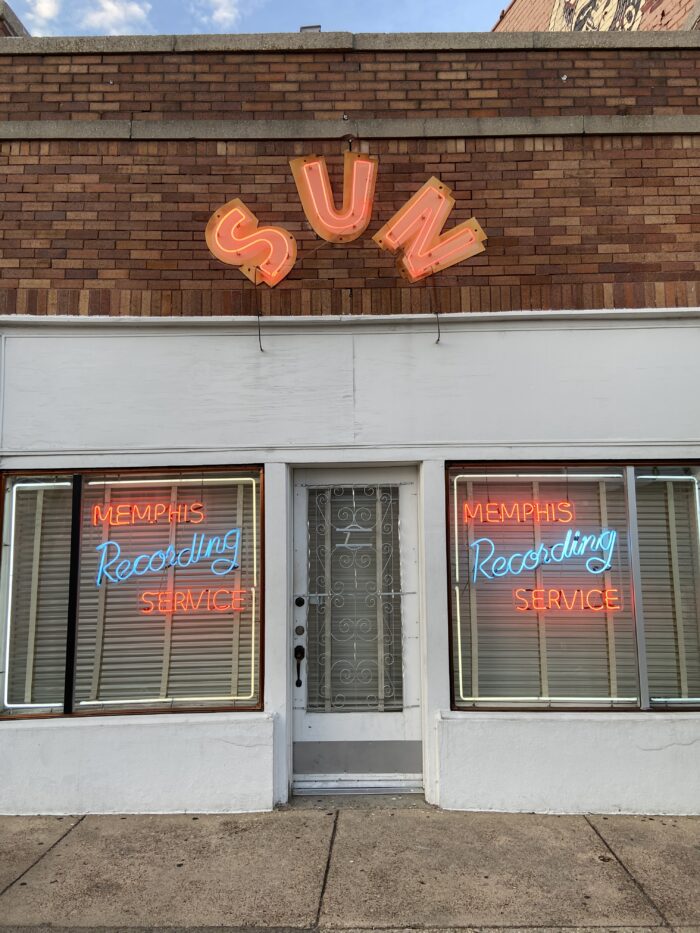
Sun Records, Memphis Tennessee – Photo by Dan Steven Erickson
In my musical journey, I’ve always leaned toward traditional formats, particularly in classic country, blues, and gospel.
Sure, I can write pop songs with the best of them, including modern country. But going back to traditional call-and-response formats, AABA patterns, and 12-bar progressions is exteremely satisfying.
And even though I was once told that I’d win the if Rodney Crowell’s songwriting camp was a contest for the most commercial song, I’m really a bit of an anti-commercialism kind of guy.
All of this to lead into my latest lyric, and likely, song, soon to be recorded and posted to my YouTube Channel. It’s called, “I Think I’m in the Wrong Town.” In the song, a “little bird” tells the narrator that although he landed in Nashville, he should be in Memphis.
Yes, the story is about me.
I’ve always had a strong draw toward Memphis and New Orleans as music cities. They seem more real, less influenced by the corrupt commercial industry. And these days, the industry seems to continue to make music more sterile by using too many automated and electronic tools like drum machines and autotune.
As I get closer to retirement, I’ll consider the option of moving closer to Memphis or New Orleans. No, I’m not going to pack my bags and move tomorrow. And maybe my roots will wind up pulling me back toward Maine. But I won’t throw places like Memphis and New Orleans out of the realm of possibilities.
Here’s the lyrics to the upcoming song.
I Think I’m in the Wrong Town
Well, I’ve been on a journey In search of my home
For forty long years
All I’ve done is roam
Just when I thought I’d found it
And I started to settle down
I heard a bird outside my window
And I swear I heard him say
Mister, you’re in the wrong town
He said, sure, you’re close to Nashville And those Nashville cats are cool
But brother you belong in Memphis
Where the blues and gospel rule
And as he flew off to the West
He looked back around, and he squawked
Mister Dan Steven, you’re in the wrong town
Lawd, I think I’m in the wrong town You know it ain’t bad but it ain’t my sound
It’s time to pack up my guitar
And turn myself around
Lawd, lawd, lawd, I think I’m in the wrong town
I’ve got nothing against this place
It just lacks a little soul
I think about Stax and Royale records
And the birth of rock and roll
Now something keeps pulling me
A little further to the West
I guess I took a wrong turn
But I’m willing to confess
Lawd, I think I’m in the wrong town You know it ain’t bad but it ain’t my sound
It’s time to pack up my guitar
And turn myself around
Lawd, lawd, lawd, I think I’m in the wrong town
I’m going down to the Big Muddy I’m going down, down, down
I’m going down to Memphis
And then I’m Mississippi bound
Lawd, I think I’m in the wrong town You know it ain’t bad but it ain’t my sound
It’s time to pack up my guitar
And turn myself around
Lawd, lawd, lawd, I think I’m in the wrong town
I’ve started posting some of the songs I wrote clear back in 1991 onto the YouTube Channel.
In 1991, I wrote 50-75 songs. About a third of those were co-written with friends from Washington and Nashville. I’ll be saving some of the co-written songs for future use. But I’ve chosen about 15 songs that I wrote in 1991 to rework.
Most of the songs will be recreated very close to the originals. However, I do not currently have access to any of my old recordings or written chord progressions, only lyrics. So in some cases, I might make some minor changes due to not having things fully memorized.
I already posted the first song of the project, and the only co-written song I’m including in the batch. It’s called “Building Fences.” It was the first song I wrote with Steve Graham. And the only song from our catalog that did not get into the audio recordings due to recording error.
I started a YouTube Channel back in January. My primary goal for the channel was to simply use it as a place to catalog my own music. I’ve written hundreds of songs and using YouTube seemed like an easy way to get some of them in one place.
I’m going to continue to do that. However, I thought it might be fun to bring others on the channel to share their own songs, to talk about music, recording techniques, or just to jam.
There are some channels out there like Rick Beato and Professor of Rock that do the kind of things that I’ve been thinking about. However, they focus on well-known names. I’d like to focus more on new talent and up-and-coming artists. I’d like the emphasis to be more on the songwriting process itself, and to showcase new writers.
I’d also love to have guests who understand how to set up simple recording studios and guests who know a little about music history, whether blues, country, or Rock & Roll.
If you have something to offer and would like to one of my first guests, I’d love to hear from you. I know it’s a long shot. People are busy doing their own things, but I see a place for a channel that focuses on new talent.
I know creating a successful YouTube Channel is also a long shot. I don’t really care. That’s not my goal. My goal is simply to do what I do, share the stage, and have fun. If you live near Nashville and you’re interested, send me an email at danstevenerickson@gmail.com, or hit me up on Facebook Messenger.
Let’s do this. I mean, why not? We only live once, right? – dse