Honesty

I might not know exactly what I’m doing here. I don’t claim to have all the answers. I’m not a self-proclaimed creativity guru or minimalist preacher, but honesty is important to me.

The concept of the blog is intriguing. It started out as a web log, an online version of a diary made public. Early blogs were not created to make money but rather to document life and share one’s journey. There was a sense of honesty involved.

Soon after the blog format was created, some realized they could monetize the format. Blogs became a trend and had specific rules. The goal was to choose a niche and post regularly about that topic, (even if you didn’t really know jack shit about it). The blogger became the guru.

The blogger then found ways to create marketable content and watched the money roll in. Except it was never really that simple. Only about 10% of all bloggers have made a dime.

I got into the world of blogging around 2012. It was toward the end of the era of honesty in blogging. By the time I tried my hand at blogging it had become all about making money. I don’t have a problem with making money but something started to feel disingenuous about the whole thing.

Blogging has become somewhat passé now. There are bloggers who are still cashing in, not as many startups as there used to be. It feels a little like a lost art. Podcasting, vlogging, and other formats have overridden the pure written format.

I don’t like to call myself a blogger anymore. The term almost feels dirty, like my sole reason for doing what I do would be to make money at the expense of having less honesty. Yuk.

So for now, this is just my website, my web log, and a place where I can share and sell some of my creative works. – dse
The Clock

My mother passed away on January 1, 2022. After she died we sorted through the things in her home. There wasn’t much I wanted, a few odds and ends. I did take one special item.

The clock.

Mom had a love of clocks. She owned several fun clocks. There was one that made bird chirping sounds in the dining room, and another, a Seiko, that had a face that opened up each hour. You can watch the gears turn while the clock plays a little tune. There are two settings, one for Christmas season, and another for the rest of the year.

No one wanted the clock. I hesitated, but decided I’d take it. When we moved to Maine, I brought it with us.

Now that you know the story behind the clock, there’s more.

Like my mother, I love clocks. There is something calming about the sound of a ticking clock. It’s a metronome, and a reminder that we only get so much time on the planet. Much of my electronic music is recorded at 60 beats per minute to match the meter of time. That meter is natural and meditative.

The clock won’t stop. Time keeps moving. Take a few moments to listen to the tick-tock of a clock while contemplating life and creativity. Where do you hope to be in a year, five years, ten years? What do you hope to accomplish as an author, musician, or artist?

There are no guarantees in life, but it’s more likely than not that the clock is on your side. – dse

Purposeful

Creativity might have a mind of her own, but that doesn’t mean we can’t be purposeful in what we do. There’s no forcing creativity. Still, you can choose what you create.

Anderhill was a purposeful project. I’d written a couple of albums of electronic music as Dan Erickson but wanted to do something different, darker, edgier. That’s when I created The Beginning.

I sat down with my iPad and purposefully worked at creating something edgier than I’d ever made. The Beginning starts with my first drone piece, “Welcome.” From there it gets heavier with “Echo of Things to Come.”

Throughout the 7-song EP, the sound that would start a long journey into the world of experimental electronic music as Anderhill was born. It was a purposeful endeavor. I invited creativity in and she worked her magic – dse

The Mandolin, the Ghost, and the Machine

New Anderhill music is out. This is my first full album since The Beauty of Infinite Sadness.

The Mandolin, the Ghost, and the Machine is a concept album that makes use of a mandolin on each of the nine tracks. As the composer of this experimental electronic music I have mixed feelings. Take a listen and see what you think and I’ll be my own critic below.

The album was made quickly. I created the nine tracks in a matter of a week. I often compose music quickly but this time only some of the tracks felt like they came together and others seemed oddly incomplete or not good enough. However, instead of killing tracks or the entire project I pushed forward.

The music is hard to fit into any category. It’s not ambient. It’s not house. It has some drone qualities. It’s experimental. As I worked through the project I became critical of the music and my own creative processes. Whereas I liked my opening track, “The Ghost in the Mandolin,” I became less inspired with some of the other tracks. The music began to feel too repetitive and machine-like. So I commented on that problem with the tracks, “Bloody Machine” and “Bah Bah Boom Chick.” The track “Almost” is just that. It’s almost good enough, but not quite.

Next there’s my use of the mandolin. I’m almost ashamed for bastardizing such a beautiful instrument. Rather than playing the mandolin I just haphazardly plucked and strummed short bits, sampled them, and programmed them as the first track of each recording. Then I built music around them using ghostly sounds. Finally, I added manipulated and distorted drums.

Some of the tracks feel a bit too cluttered for me. Instead of editing some of that clutter out as I often would, I decided to leave it. This work is exactly how I created it.

You might wonder why I’d even release The Mandolin, the Ghost, and the Machine if I dislike it as the composer. Let me explain. First, I don’t dislike it. I think it could be better. I think I’ve composed stronger works. I feel less passionate about the album than others I’ve created. That doesn’t make it bad.

Second, it’s art. Some might disagree. My process was simply to use a concept, in this case samples of a mandolin as the building block for the music. I created nine pieces quickly and in the order you hear them. And although I was critical of my own process I forged ahead.

Finally, it’s often been my observation that the works we are most critical of as artists, creators, and composers are often the viewers, readers, and listeners favorites. I can’t count the times that I’ve been about to throw something away but several people told me it was one of my best works. In that spirit I decided to release this album for better or worse. – dse

Drone

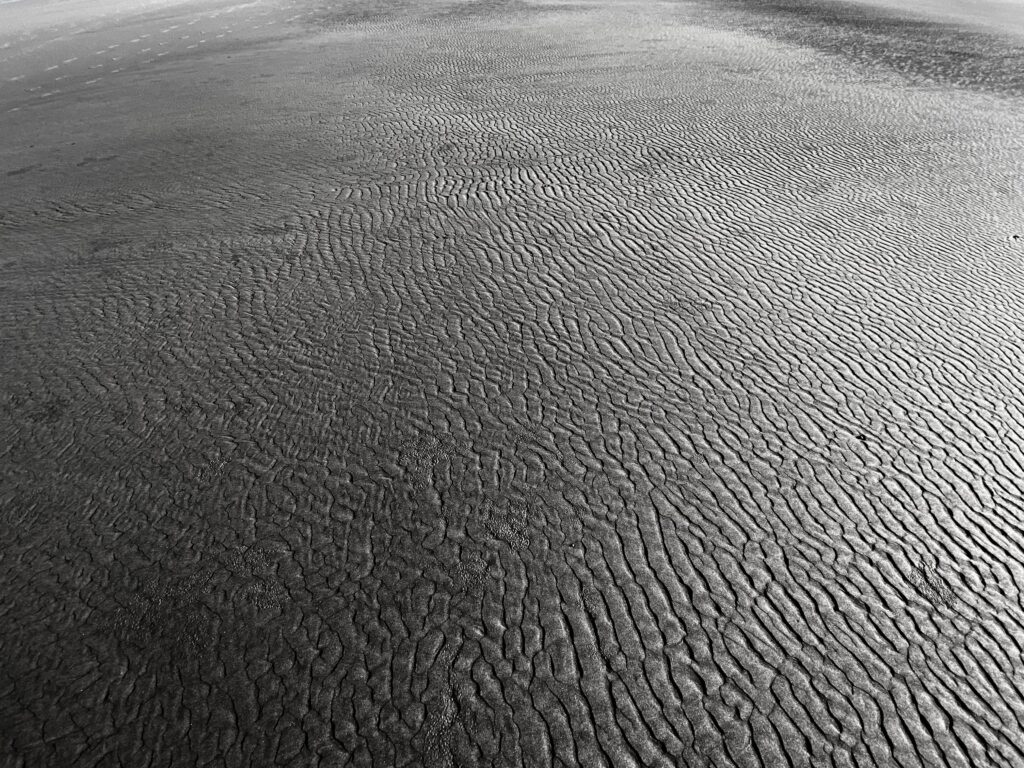
Abstract, Oregon Coast – Photo by Dan Erickson

I know drone music isn’t most peoples’ thing. You want beats and words and something exciting, not just a few intertwined notes playing endlessly. Personally, I love a good drone composition and believe that a similar concept can be applied to many other areas in life.

Drone music is hypnotic and meditative. I’m often amused by all the people who listen to “chill” music but snub drone. Chill is simply drone’s distant pop-music cousin. Drone is less distracting because there is very little if any melodic structure.

Drone is also likely the world’s oldest form of music.

Listen to The Beauty of Infinite Sadness.

Let’s apply this concept of a drone to other areas in life. I’m not big on “finding your niche” and sticking with a single topic as a writer. But wouldn’t that be a little drone-like? Writing about the same thing again and again?

A drone is constant and steady. That’s exactly how we can become more productive, by being constant and steady. I can both meditate and work while listening to drone music. I know that might sound like an oxymoron, but it works. Work itself can be a meditation.

I hear someone thinking, “but drone music is boring.” Listen closely. There’s likely many more musical nuanses in a well-composed drone composition than in your favorite pop song. – dse

Digital Distractions

I might have written a few more books in the last five years if it wasn’t for digital distractions. In today’s world we’re flooded with them.

Is there any way to stop the madness? I’m not sure. It seems we’ve almost been programmed to be distracted in this day and age. Think of all the crap that keeps us from doing more productive activities.

  • Smart phones
  • Social media
  • Television
  • Customer service
  • Video games
  • Technology upkeep
  • Direct messaging
  • Email

The list could go on but I’m only focusing on the more common digital distractions. How many times have you found yourself scrolling Facebook or watching Netflix when you might have been creating something? Thousands? I know it’s a constant problem for me.

How can we stop from being overwhelmed by all these distractions? Short of opting out of the modern world I’m not sure we can. I’ve already limited my social media but I’ve often thought about completely eliminating the Internet when I retire. How then would I keep doing this? Creating and sharing? Could I even pay my bills? It’s a two-edged sword.

The only way to have less digital distractions is to practice discipline.

  • Set up an hour a day to go digital free
  • Save one day a week to specifically work on creative projects
  • Take a digital-free weekend once a month

You know all this stuff.

They’re great ideas in theory, but remember you don’t really control your creativity. It leads you. This creates another complication but don’t fret.

My experience has been that creativity is stronger than distraction. Simply put, when the muse is active, I’m working. When I’m working, I’m less distracted. – dse